
Introduction
Over the years, I’ve realized that a small kitchen isn’t the biggest challenge poor organization is. I’ve worked with kitchens where cabinets were overflowing with pots, pans, and lids, yet a few simple changes made the space feel twice as functional.
That’s why I always tell people that you don’t need a bigger kitchen; you just need a smarter system. If you’re trying to organize pots and pans in small kitchens, you’re in the right place. The methods I’m sharing aren’t just popular storage hacks they’re practical techniques.
I’ve seen them work in real kitchens. Whether you’re dealing with one crowded cabinet or very limited storage, these ideas will help you make better use of the space you already have. For more practical storage tips, check out our Smart Kitchen Organization Ideas for Small Spaces guide.
I recommend solutions, along with the common mistakes to avoid and the small changes that make the biggest difference. By the end, you’ll have an organized kitchen that’s easier to cook in and much simpler to keep tidy.
Why Pots and Pans Get Out of Control in Small Kitchens
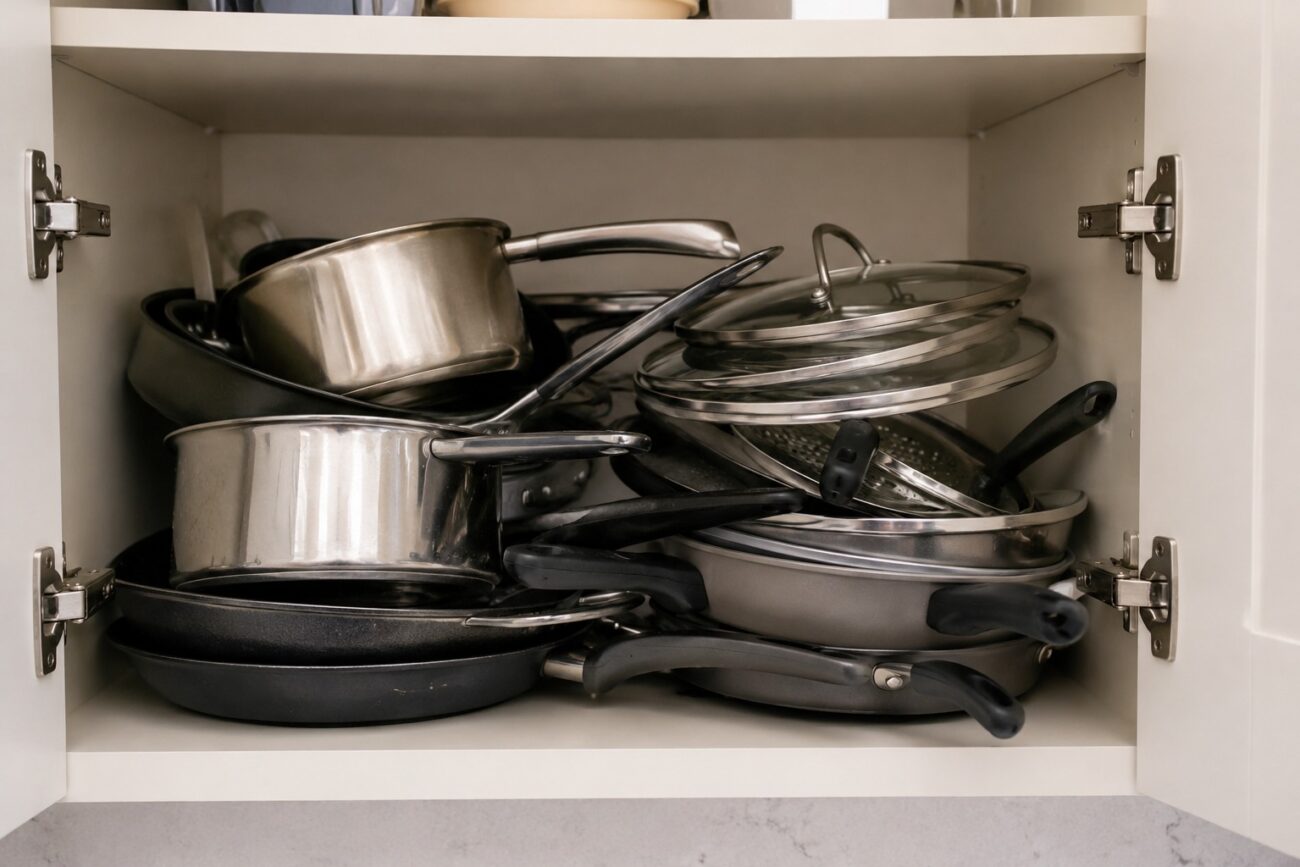
Most of the mess in a little kitchen has nothing to do with having too many pots and pans. It’s about cookware living in the wrong place. Lower cabinets are usually deep and gloomy; thus, pots get pushed back and forgotten.
Rarely have a place of their own, lids end up piled haphazardly on top of pots or stuffed into whatever space remains. And in many modern homes and studio-style apartments, there isn’t much of a separate cabinet for cooking supplies.
In short: if you can’t see what you own or reach it easily, your kitchen will always feel more cluttered than it actually is.
For years, kitchens have also been getting smaller, particularly in cities and more recent apartment complexes, which makes more people attempting to fit a complete set of pots in less room than kitchens used to have.
That’s simply the reality of living in a small space; it’s not a personal failure, which is precisely why a better system is more important than purchasing more goods.
Start With a Quick Cookware Audit
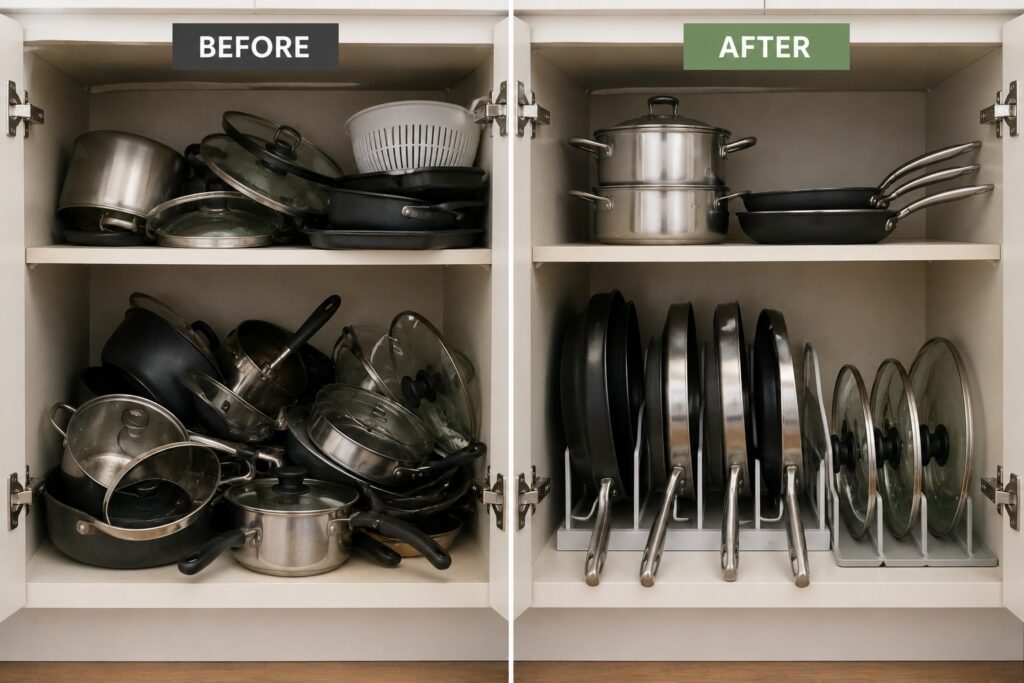
Clear everything out of your cabinets and spread it on the counter before you arrange anything. Though repetitive, this is the quickest approach to release actual space.
Ask yourself:
- Do I use this pan or pot at least once every month?
- Do I have a copy that seldom gets used?
- This pot is missing its lid; this lid is missing its matching pot.
- Is the nonstick coating damaged or peeling?
Three frying pans and only ever reach for one means it’s time to let two of them go. Give whatever is still in good condition; throw everything with damaged coating; it poses a health risk and takes up closet space.
Choose the Right Storage Method for Your Kitchen Type
Every little kitchen isn’t set up the same way, thus the appropriate approach relies on what you’re really working with.
If You Have Lower Cabinets
This is the most common setup, and it gives you the most flexibility. A few options work especially well here:
- Nesting or stackable cookware sets:
These can save 40–50% of your cabinet space compared to mismatched pieces, since each piece is designed to sit inside the next
- Pull-out shelves: Turn a deep, awkward cabinet into something you can actually see into without kneeling on the floor
- Deep drawer dividers: Keep pans upright instead of stacked, so you’re not digging to the bottom every time you need one
If You Have Open Shelving or No Cabinets
Some tiny kitchens instead use open shelving, or just lack enough cabinet capacity for tools. In that event, search up and outward rather than downward:
- A wall-mounted rail: Near the stove keeps your most-used pans within arm’s reach
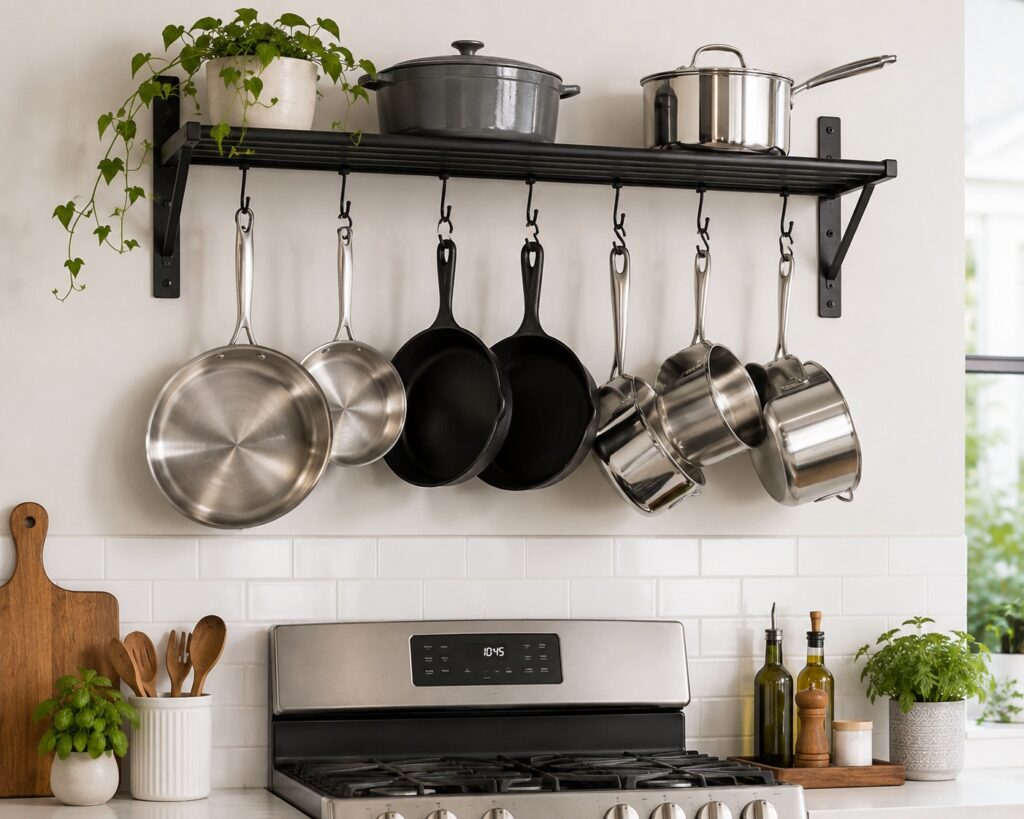
- A ceiling-mounted pot rack: Works well over an island or open counter and doubles as a design feature
- Freestanding shelving units: Give you a dedicated cookware zone even without built-in storage
A hanging rail installed just above the stove is often the single easiest upgrade for kitchens with no lower cabinets — everything stays visible, and nothing gets buried.
If You’re in a Studio or Micro-Kitchen
When square footage is at its tightest, think vertical and mobile:
- A narrow rolling cart tucked beside the fridge or stove adds storage without eating into counter space
- Over-the-door racks make use of the back of a pantry or cabinet door
Under-shelf baskets grab the dead space just below an existing shelf
| Kitchen type | Best Method | Example Storage Type |
| Lower cabinets | Nesting sets, pull-out shelves, drawer dividers | Stackable cookware, cabinet organizers |
| Open shelving / no cabinets | Wall or ceiling-mounted storage | Hanging pot rack, wall rail |
| Studio / micro-kitchen | Vertical, mobile storage | Rolling cart, over-the-door rack |
Solve the Lid Problem Once and For All
Lids mess up more tiny kitchens than the pots do. Their strange shapes, poor stacking, and first-thing-to-open-a-cabinet status define them.
Almost immediately, a basic vertical cover rack helps you to view and grab the one you want without upsetting anything else by means of side-by side lids standing upright.
If cabinet space is tight, a tension-rod divider creates instant vertical slots inside an existing cabinet for next to nothing.
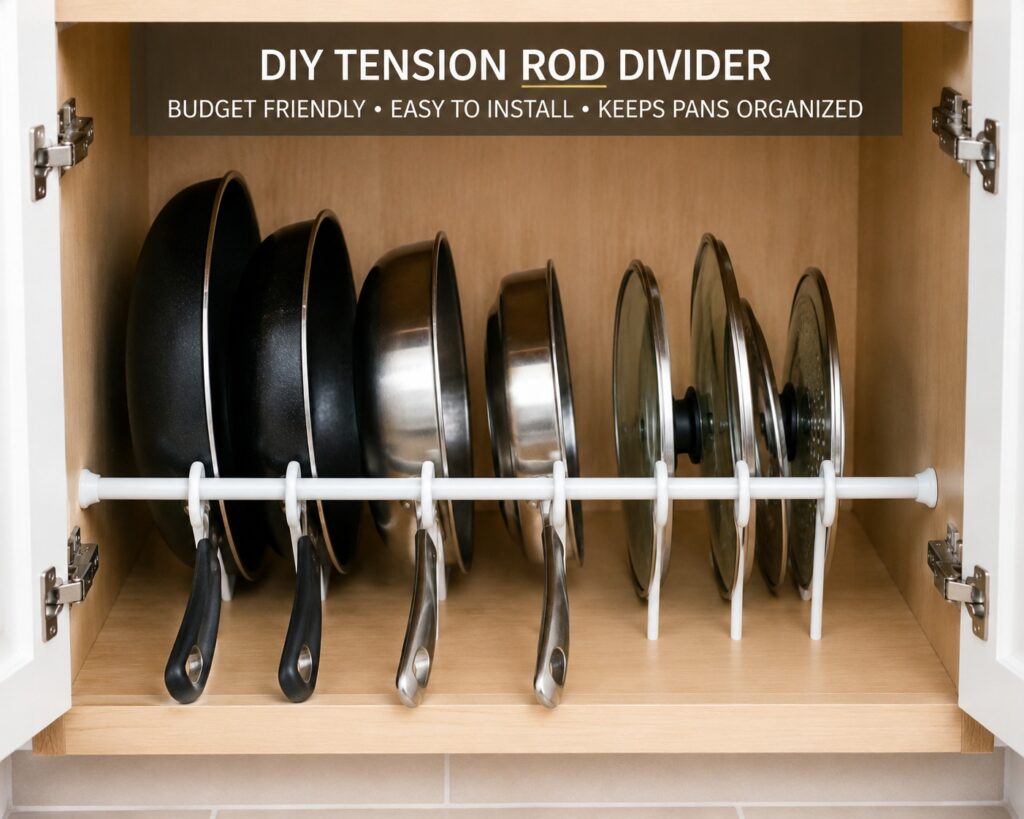
For kitchens with a bit more room, a lid rack mounted inside a cabinet door keeps lids completely out of the way while still being easy to reach.
Use the “Zone” Method Experts Recommend
Professional organizers usually advise grouping things by how frequently you use them and how near they will be used; cookware is a great candidate for this strategy.
Ideally close to the stove, your daily frying pan and little saucepan should be at eye level or in the most easily accessible area. Pots you reach for weekly can sit just below or beside that zone.
Anything you only pull out a few times a year — a roasting pan, a large stockpot — belongs on a top shelf or in the back of a cabinet, since it doesn’t need to be convenient.
This one shift, storing cookware by frequency of use instead of by size or set, is often what makes a small kitchen finally feel manageable.
Not sure which pot rack fits your kitchen? Check out our full guide to the best pots and pans organizers for small kitchens for specific product picks.
Mistakes to Avoid
- Stacking pans without protectors. Bare metal-on-metal stacking scratches nonstick coatings fast. A felt pan protector between each piece prevents this in seconds.
- Overstuffing one cabinet. Cramming everything into a single spot just recreates the same clutter you started with. Spread cookware across zones instead.
- Ignoring vertical space. Empty air above your pots is wasted storage. Lid racks and stackable risers make use of it.
Buying organizers before measuring. A pull-out shelf or drawer divider that doesn’t fit your cabinet’s exact dimensions will sit unused. Measure first, buy second.
Conclusion
You may clean a disorganized cookware cabinet without having to redo your entire kitchen. Start with a brief audit, select the storage technique best suited for your kitchen style, solve the cover problem, then arrange everything according to actual usage frequency.
Done in the right order, little adjustments add up to a kitchen that is eventually organized. Choose one piece of advice from this manual and make use of it this week.
The rest of the system becomes much simpler to manage once you see how much room it frees up; we would want to know which technique proved most effective in your own little kitchen.
Frequently Asked Questions
How do you store pots and pans if you don’t have a cabinet?
Wall-mounted rails, ceiling-hung pot racks, and freestanding shelving units all work well when there’s no dedicated cabinet space. Choose whichever fits closest to your stove for easy access.
Is it better to hang pots and pans or store them in cabinets?
Neither is universally better — it depends on your kitchen. Hanging storage works well when cabinet space is limited or nonexistent, while cabinets keep cookware out of sight if you prefer a cleaner look.
How often should I declutter my cookware?
Once or twice a year is usually enough. A quick check every six months keeps duplicates and damaged pieces from piling back up.
What’s the cheapest way to organize pots and pans?
Tension-rod dividers and command hooks are two of the most budget-friendly options, and both can be installed in minutes without tools or drilling.
